Agent Config
A shared configuration workflow that turns authored fragments into instructions for different coding tools. The example compares generated outputs and shows what becomes stale when a source fragment changes.
- Contribution
- I built and maintain the compiler, runtime, adapters, and integration that turn shared fragments into tool-specific instructions.
- Maturity
- Implemented
Interactive simulation · Illustrative outputs
Primary demonstration
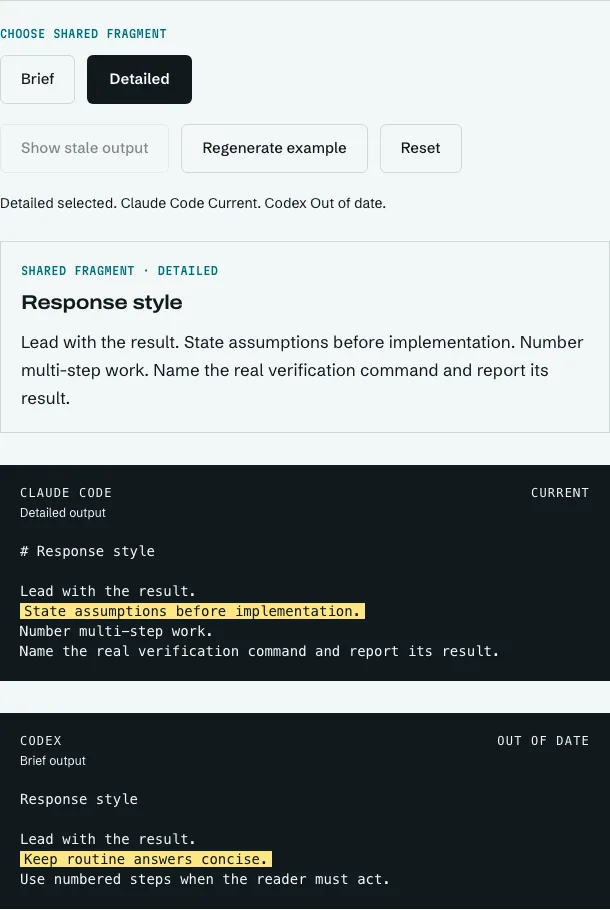
Portfolio simulation screenshot with Illustrative outputs: the Detailed shared fragment and Claude Code output remain current while Codex shows the Brief output as Out of date. The stacked layout preserves the complete visible excerpts. No real compiler was run and no source stamp was produced.
Compiler example · fixture simulation
Illustrative outputs
A harmless formatting preference rendered as purpose-written Brief and Detailed examples. No real compiler output or source stamp is shown.
Public example checked 2026-09-12. Portfolio simulation screenshot with Illustrative outputs: the Detailed shared fragment and Claude Code output remain current while Codex shows the Brief output as Out of date. The stacked layout preserves the complete visible excerpts. No real compiler was run and no source stamp was produced.
Media: text-based illustrative fixture. Role: shared policy comparison. Maturity: Implemented.
Limits: this browser example does not read configuration, invoke a compiler or model, change a repository, use storage, or contact a service.
Brief · initial server reference
Response style
Text-based sample evidence
Shared fragment · Brief
Lead with the result. Keep routine answers concise. Use numbered steps when the reader must act.
Claude Code
Brief output
Current
# Response style

Lead with the result.
Keep routine answers concise.
Use numbered steps when the reader must act.
Codex
Brief output
Current
Response style

Lead with the result.
Keep routine answers concise.
Use numbered steps when the reader must act.
Both illustrative outputs are Current. This frame stays available if the controls cannot load, and the complete Brief, Detailed, stale, regenerate, and Reset walkthrough remains below it.
Interactive controls load when this example comes into view.
If the interactive example stops responding, Reload this example.
Problem and workflow
The problem
Agent tools often need the same working rules in different instruction formats. Copying those rules by hand makes drift easy: one tool may receive a concise response policy while another keeps an older, more detailed version. The mismatch can be hard to notice because both files still look reasonable on their own. A useful compiler must keep shared intent in one place, adapt it to each tool, and make regeneration inspectable. This example focuses on that synchronization problem without exposing a private configuration or running the actual generation pipeline in the browser.
The workflow
Choose the purpose-written Brief or Detailed fragment. The shared fragment and both illustrative tool outputs update together, which represents a clean generation pass. Show stale output then keeps Claude Code aligned with the selected fragment while Codex displays the opposite fixture variant and an Out of date label. Regenerate example restores the matching Codex output. Reset returns to Brief with both outputs Current. These controls select fixed public examples; they do not edit files, calculate a source stamp, invoke the compiler, or inspect a local configuration.
01Change the shared preference
- 01The server-rendered first frame starts with Brief selected. The shared fragment, Claude Code output, and Codex output all show the Brief example and both outputs read Current.
- 02Select Detailed. All three panels move to the Detailed fixture in one state change, and any previous stale state is cleared.
- 03Select Show stale output. The shared fragment and Claude Code stay Detailed, while Codex uses the Brief output and reads Out of date. The differing instruction is highlighted.
- 04Select Regenerate example. Codex returns to the Detailed output and reads Current. Repeating regeneration cannot move the example into another state.
02Check the opposite stale direction
- 01Select Brief from any state. The shared fragment and both outputs move to Brief, and stale state clears.
- 02Select Show stale output. Claude Code remains on Brief and Current, while Codex displays the Detailed fixture and reads Out of date.
- 03Select Reset. The example returns to Brief with both outputs Current. No setting is written to storage or added to the page URL.
Engineering and evidence
Decision 01
The browser must explain configuration drift without becoming another compiler.
- Choice
- Use two strict, server-projected variants and a small Agent Config-specific reducer that only selects fixture content.
- Consequence
- The interaction stays deterministic and cannot read configuration files, accept arbitrary instructions, invoke generation, or invent a verified source stamp.
Decision 02
A stale example must show a real mismatch instead of changing a badge alone.
- Choice
- Keep Claude Code on the selected variant and source Codex from the opposite fixture pair whenever stale state is active.
- Consequence
- The fragment, output variant, highlighted excerpt, and Current or Out of date labels remain connected to the same supplied fixture.
Decision 03
Shared rules still need tool-specific formatting.
- Choice
- Project separate Claude Code and Codex examples from each harmless shared fragment while keeping the source content server-only.
- Consequence
- Visitors can compare adapters without receiving unrelated fixtures, private paths, compiler internals, or canonical configuration data.
Contribution and credits
I built and maintain the compiler, runtime, adapters, and integration that turn shared fragments into tool-specific instructions.
- My contribution is the compiler, runtime, tool adapters, and integration that assemble and deliver the generated instructions.
- Imported skills and hooks remain separate inputs with their own authorship and licenses. This showcase does not claim those projects as my work.
Current limits
- The displayed fragments and outputs are purpose-written illustrations. They were not captured from the real compiler and carry no source stamp.
- The example covers Brief, Detailed, stale Codex output, regeneration, and Reset. The review-finding funnel and dated session-continuity evidence remain outside this version.
- The browser makes no compiler, model, filesystem, repository, storage, messaging, or network call for the demonstration.
About this example
Purpose-written portfolio simulation checked September 12, 2026. The overview image shows the local example with Illustrative outputs; every fragment and output excerpt was authored for this page. The outputs remain illustrative after review because no real compiler was run. No canonical configuration, private project source, compiler capture, or source stamp was used. The evidence manifest binds the exact public sample and poster bytes without claiming a compiler-generated digest.
Checked September 12, 2026
Evidence details
Portfolio simulation screenshot with Illustrative outputs: the Detailed shared fragment and Claude Code output remain current while Codex shows the Brief output as Out of date. The stacked layout preserves the complete visible excerpts. No real compiler was run and no source stamp was produced.
illustrative